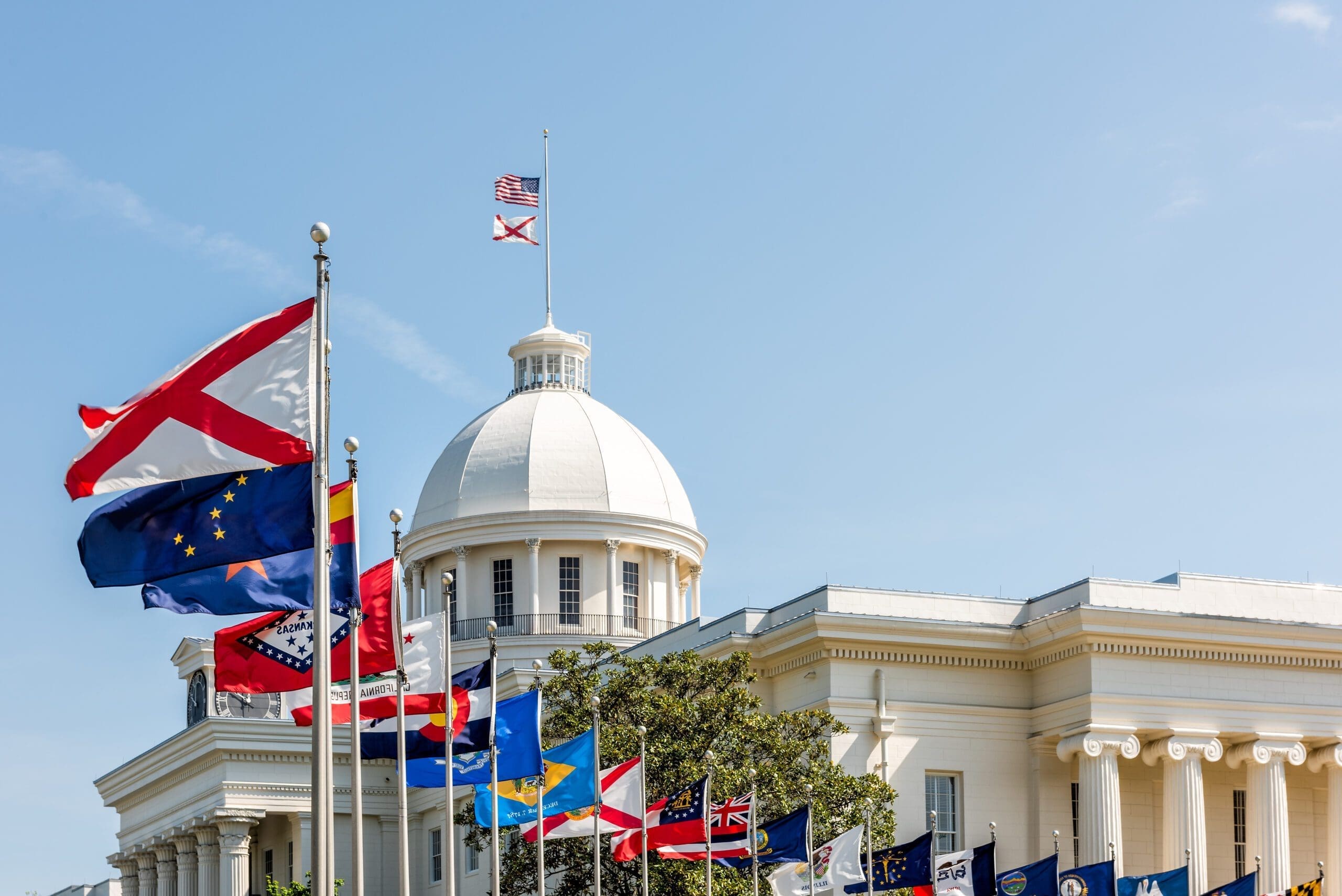
The Alabama legislature officially reached the halfway point of the 2026 legislative session in February, and activity is ramping up around the capitol. Lawmakers passed several new bills over the course of February, including bills regarding environmental policy, criminal justice and more.
Check out some of the bills that made their way through the legislature this month, as well as some bills to watch as March begins.
Five bills passed in February:
Bill Name: HB181
Sponsors: Reps. Rhett Marques, R-Enterprise; Donna Givens, R-Loxley; Jennifer Fidler, R-Silverhill; Frances Holk-Jones, R-Foley; Matt Simpson, R-Daphne; Chip Brown, R-Hollinger’s Island; Margie Wilcox, R-Mobile; Jeff Sorrells, R-Geneva; Brett Easterbrook, R-Fruitdale; Napoleon Bracy, D-Mobile; Sam Jones, D-Mobile; Adline Clarke, D-Mobile; Mark Shirey, R-Mobile; and Shane Stringer, R-Citronelle
Date passed: Feb. 10
HB181 limits mud dumping in Alabama waterways.
Mud dumping is particularly an issue in the Mobile Bay, where the ship channel leading from the Gulf of Mexico to the Port of Mobile must be dredged regularly by the U.S. Army Corps of Engineers in order to maintain its required depth of 50 feet. The sediment dredged from the channel is typically disposed of through an open-water dispersal.
However, this type of dispersal makes the water in the bay cloudier, harms seagrasses, and disrupts the food sources of bottom-feeding animals that live in the bay. In 2024, Mobile Baykeeper threatened to sue the Army Corps of Engineering for harming the endangered gulf sturgeon, which bottom-feeds, with their dredging practices.
HB181 aims to mitigate the effects of dredging and mud-dumping by requiring any entity that dredges more than 1 million cubic yards of material to use at least 70% of their dredged material for a beneficial use. The bill stipulates that beneficial uses could include “fish and wildlife habitat development, human recreation, and industrial and commercial uses,” but that releasing dredged materials into public waters does not count as a beneficial use unless it is for the express purpose of shoreline restoration or marsh creation projects.
Bill Name: HB41
Sponsors: Reps. Matt Simpson, R-Daphne; Nathaniel Ledbetter, R-Rainsville; Andy Whitt, R-Harvest; Danny Garrett, R-Trussville; Paul W. Lee, R-Dothan; Rhett Marques, R-Enterprise; Rex Reynolds, R-Huntsville; Chris Blackshear, R-Phenix City; Leigh Hulsey, R-Helena; Matthew Hammett, R-Andalusia; Joe Lovvorn, R-Auburn; Kerry Underwood, R-Tuscumbia; Danny Crawford, R-Athens; Marcus Paramore, R-Troy; Brett Easterbrook, R-Fruitdale; Bryan Brinyark, R-Northport; Ernie Yarbrough, R-Trinity; Ginny Shaver, R-Leesburg; Susan DuBose, R-Hoover; Reed Ingram, R-Pike Road; Bill Lamb, R-Tuscaloosa; Jim Carns, R-Vestavia Hills; Shane Stringer, R-Citronelle; Allen Treadaway, R-Morris; Russell Bedsole, R-Alabaster; Mack Butler, R-Rainbow City; Margie Wilcox, R-Mobile; Ed Oliver, R-Dadeville; Jeana Ross, R-Guntersville; Arnold Mooney, R-Indian Springs; Chris Sells, R-Greeneville; Chad Robertson, R-Heflin; Mark Shirey, R-Mobile; Ron Bolton, R-Northpoint; Donna Givens, R-Loxely; Brock Colvin, R-Albertville; Scott Standridge, R-Hartselle; Randy Wood, R-Anniston; Jamie Kiel, R-Russellville; Troy Stubbs, R-Wetumpka; Kenneth Paschal, R-Pelham; Chip Brown, R-Hollinger’s Island; Ben Robbins, R-Sylacauga; Scott Stadthagen, R-Hartselle; Tracy Estes, R-Winfield; Phillip Rigsby, R-Huntsville; Mike Shaw, R-Hoover; Steve Hurst, R-Munford; Jerry Starnes, R-Prattville; Frances Holk-Jones, R-Foley; Mike Kirkland, R-Scottsboro; and Mark Gidley, R-Hokes Bluff
Date passed: Feb. 12
This bill, known as the “Child Predator Death Penalty Act,” makes rape of a child younger than 12 a capital offense. Those found guilty of first-degree sodomy or first-degree sexual assault will now be able to receive the death penalty under the bill’s stipulations.
Alabama lawmakers pushed HB41 in response to a child sex ring that was discovered in Bibb County last year.
“For too long, the most vulnerable of our society have lacked the most stringent legal protection from child predators,” said Gov. Kay Ivey in a press release regarding the bill, “Those who target the youngest among us for the vilest crimes will soon be met with the harshest punishment under the law.”
This law goes directly against the 2008 U.S. Supreme Court ruling in Kennedy v. Louisiana, which banned applying the death penalty in non-homicide cases. However, in recent years, several states have passed or considered similar laws, in an attempt to get the Supreme Court to reconsider their previous ruling.
Bill Name: HB161
Sponsors: Reps. Chris Sells, R-Greeneville, and Arnold Mooney, R-Indian Springs
Date passed: Feb. 17
HB161 requires app stores to implement age verification processes to bar minors from downloading apps without a parent’s consent.
The bill requires app stores to collect and verify the ages of its users in the state. Accounts for minors would then have to be linked to a parental account, and the parent would then have to give their approval before the minor can download or purchase an app or make an in-app purchase on their phone.
“HB 161 is about protecting children online and putting parents back in control. App Store is a gateway to what our children are exposed to online,” bill sponsor Chris Sells, R-Greeneville, said on the House floor.
Other states, including Utah, Texas and Louisiana, have passed similar age verification laws. However, a federal judge placed a hold on the Texas law saying that it likely violates the First Amendment. It is likely that the age verification debate will work its way up to the Supreme Court.
Bill Name: SB71
Sponsor: Sen. Donnie Chesteen, R-Geneva
Date passed: Feb. 20
SB71 restricts the state from setting environmental regulations on pollutants and other hazardous substances that are stricter than those set by the federal government. The law also stipulates, if no federal standard exists for a particular pollutant, then the state can only adopt new regulations if a “direct causal link” can be established between exposure to the pollutant and bodily harm.
The law, which greatly restricts the power of the Alabama Department of Environmental Management, is meant to attract more big businesses to the state, according to the bill’s sponsor Sen. Donnie Chesteen, R-Geneva.
“If we’re going to be able to compete with states in the Southeast to attract and bring some of these businesses in, then we need to have these standards adopted so that it’s clearly defined what our companies are working with,” Chesteen told fellow legislators during discussion of the bill.
SB71 comes into effect as the federal government is decreasing environmental regulations under President Donald Trump’s administration, with the Environmental Protection Agency repealing its own 2009 findings that greenhouse gases endanger public health in February.
Bill Name: HB66
Sponsor: Rep. Ontario Tillman, R-Bessemer
Date passed: Feb. 24
HB66 requires the Alabama State Law Enforcement Agency to create a way for individuals to voluntarily indicate that they have a medical diagnosis that may make it difficult for them to communicate on their driver’s license or non-driver ID card.
Under the bill, individuals with conditions such as autism, a traumatic brain injury, epilepsy, schizophrenia, a cognitive disability or another diagnosis that could interfere with their ability to communicate would be able to provide a proof of diagnosis to receive the special indication on their ID. The bill is intended to indicate to first responders or law enforcement that a person may have difficulty communicating with them.
Others bills that passed in February:
- SB114 — a bill that stipulates law enforcement officers may arrest someone in Alabama without a warrant so long as the individual is charged with a felony in another state.
- SB169 — a bill that increases the criminal penalty of criminally negligent homicide to Class B felony, which can result in a two to 20 year prison sentence.
- SB30 — a bill banning nondisclosure agreements regarding incidents of sexual abuse.
- SB19 — a bill eliminating deductibles, copays and other out-of-pocket fees for prostate cancer screenings for men considered to be at high risk of the disease.
Three bills to watch in March:
Bill Name: SB26
Sponsor: Sen. Chris Elliott, R-Josephine
Status: Passed by Senate; awaiting a House vote
SB26 would make it easier for local governments to remove members of local library boards.
If passed, SB26 would allow local governing bodies, such as a city council or county commission, to fire members of its associated local library board with a two-thirds vote. Under current state law, local governments can not remove library board members at will.
The bill’s sponsor, Sen. Chris Elliott, R-Josephine, said that the bill will allow “each individual municipality or county to really govern their own library.” However, critics of the bill, such as library advocacy group Read Freely Alabama, have said SB26 “would fundamentally weaken the independence of Alabama’s public library boards and open the door to greater political interference in local library decisions.”
The bill comes among years of contention between right-wing advocacy groups and the Alabama Public Library Service and local libraries across the state, which has resulted in APLS banning books containing “gender ideology” for minors and withholding funding for the Fairhope Public Library over books shelved in the library’s teen section.
SB26 passed the Senate in February with a vote of 25-6, and is now awaiting a vote from the House.
Bill Name: SB248
Sponsor: Sen. Shay Shelnutt, R-Trussville
Status: Passed by Senate; pending House Education Policy Committee
SB248 would establish rules for release time religious instruction, in which students can be released from school during the school day in order to attend religious lessons. Under the bill, local school boards would allow parents to decide if their child should be released from school for off-campus religious instruction.
Under the bill, school boards would not oversee the instruction and activities that occur during the release time. Instead, an outside religious group, such as a local church, would conduct instruction during religious release time.
Off-campus religious instruction during the school day was deemed constitutional in a 1952 U.S. Supreme Court case, Zorach v. Clauson.
The bill passed the Senate 29-0. It now goes to the House Education Policy Committee for a vote.
Bill Name: SB24
Sponsor: Sen. Linda Coleman-Madison, D-Birmingham
Status: Passed by Senate; pending House Judiciary Committee
SB24 would require the Board of Pardon and Paroles to provide more information to formerly incarcerated individuals regarding their voting rights.
Under current Alabama law, certain formerly incarcerated individuals can have their voting rights restored after they serve their prison sentence. SB24 would require the Board of Pardon and Paroles to post to their website instructions on how to request voting rights restoration, as well as an application form to do so.
If the bill is passed, the Board of Pardons and Paroles would have to start publishing a list of names of people who qualify to have their voting rights restored starting in March 2027.
The bill passed the Senate with a vote of 26-0. It is now pending approval from the House Judiciary Committee.
Author

Like our work? Then support it!

Want to get early access to columns, unique newsletters and help keep The Sunrise News active? Then support us on Ko-Fi!