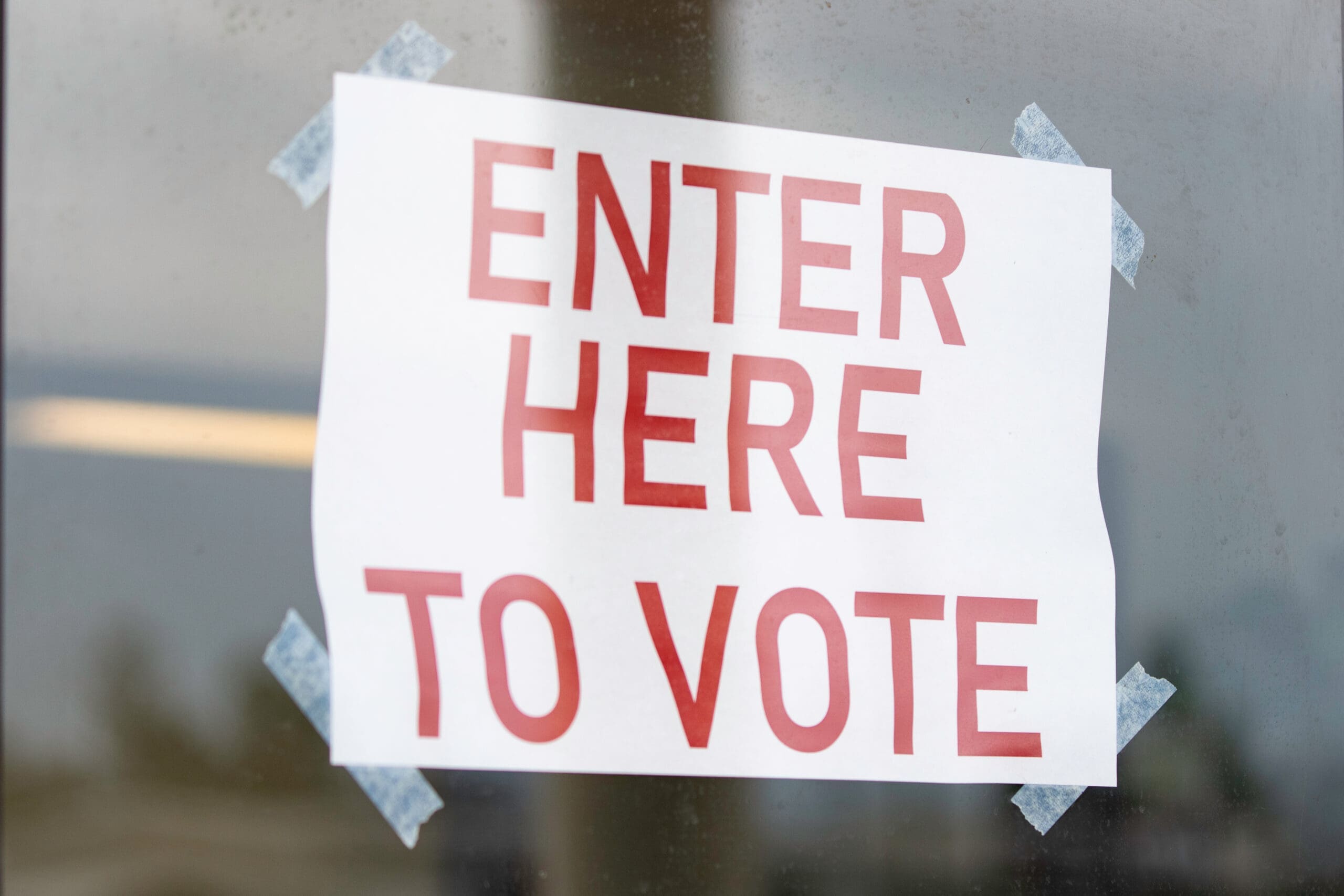
Alabama’s statewide primary elections took place last week, giving voters the chance to pick the party nominees who will appear on the ballot in November for several state offices, including governor, lieutenant governor and attorney general. Alabamians also voted in congressional races, even as recent redistricting created some confusion in those races
In the gubernatorial race, current U.S. Senator Tommy Tuberville won the Republican nomination, earning 79.1% of the vote. Tuberville bested Will Santivasci and Ken McFeeters for the party’s nomination.
On the Democratic side, Doug Jones, a former U.S. senator, beat out a crowded field to win the party’s nomination with 75.7% of the vote.
Jones and Tuberville will face off in November’s general election. This is not the first time the two have run against each other — Tuberville beat out Jones for the U.S. Senate in 2020. At his election party, Tuberville painted the race ahead as a moral crusade.
“I’m running against socialism. and communism. I’m running against people that believe in killing the unborn. I’m running against people, My God, folks, I’m running against people that I don’t know if they believe in God anymore,” Tuberville told his supporters after securing his primary election win.
Since his victory, Jones has been back on the campaign trail, holding an event last week in Birmingham where Kentucky Gov. Andy Beshear, the chair of the Democratic Governors’ Association, endorsed his campaign.
Meanwhile, several other statewide races are moving on to run-off, including the Republican lieutenant governor race. Current Secretary of State Wes Allen and former Alabama Republican Party chair and Alabama Public Library Service chair John Wahl will face off against each other again in June’s run-off election.
For the Democrats, current state Rep. Phillip Ensler, D-Montgomery, beat out Darryl D. Perryman with 60.3% of the vote.
The Republican attorney general race will also proceed to a run-off between former Alabama Supreme Court Justice Jay Mitchell and current Deputy Attorney General Katherine Robertson. The race between the two has been heated, with Mitchell accusing Robertson of receiving money from “dark money” groups — nonprofits that do not have to disclose their donors.
For the Democrats, former state Rep. Jeffrey McLaughlin ran unopposed in the attorney general race.
There will be two other Republican run-offs for statewide offices in June: Corey Hill and Christina Woerner McInnis in the agriculture commissioner race and Chris Beeker and Jim Ziegler for a spot on the Public Service Commission.
Alabamians also voted for congressional representatives last week, though these races were nullified in Districts 1, 2, 6 and 7 due to redistricting that was greenlit by the Supreme Court just a week before the primary. Voters in these districts will vote in their congressional primary in an August special election. Results for Districts 3, 4 and 5 are as follows:
- In District 3, Lee McInnis won the Democratic nomination, while incumbent U.S. Rep. Mike Rodgers won the Republican nomination.
- In District 4, Democrat Amanda Pusczek won her party’s nomination. Incumbent U.S. Rep. Robert Aderholt won the Republican nomination.
- In District 5, incumbent U.S. Rep. Dale Strong won the Republican nomination. There will be a run-off for the Democratic nomination between Andrew Sneed and Candice Duvieilh.
Overall, voter turnout was down slightly across the state, 23.11% of registered voters casting their ballot in this year’s primary — compared to 23.4% in 2022’s primary.
However, voter turnout actually rose in two of the state’s largest Democrat-leaning counties. In Montgomery County, voter turnout rose from 20.78% in the 2022 primary to 30.48% this year. Jefferson County voter turnout also increased from 22.35% four years ago to 26.58% this year. Most of the counties that make up Alabama’s Black Belt also saw increased voter turnout.
Run-off elections will take place across the state on June 16.
Alabama top stories in brief
Supreme Court dismisses Alabama’s bid to execute inmate with intellectual disability
- The U.S. Supreme Court dismissed an appeal from the state asking the court to overturn a lower court ruling that barred the state from executing a death row inmate who has been found to be intellectually disabled.
- The dismissal means that the lower court’s ruling will stand.
- Under that ruling, the state can not execute Joseph Clifton Smith, a 55-year-old man who was convicted of beating a man to death in 1997.
- The Supreme Court barred states from executing people with intellectual disabilities in 2002. However, the state claims that Smith is not intellectually disabled because he has scored above 70 on some IQ tests — the level that is generally pointed to as the threshold of intellectual disability.
Alabama one of seven states targeted in NAACP athletics boycott
- The NAACP and Congressional Black Caucus have called for Black athletes and fans to boycott athletics at public universities in several Southern states, including Alabama, in response to redistricting efforts in these states that the civil rights groups say discriminate against Black voters.
- The boycott campaign, called “Out of Bounds,” urges current and prospective Black athletes, their families, alumni and fans to “withhold athletic and financial support” from public university athletic programs in Alabama, Florida, Georgia, Louisiana, Mississippi, Texas and South Carolina.
- In a press conference at the U.S. Capitol last week, NAACP President Derrick Johnson criticized states for benefiting from Black athletes while simultaneously diminishing their Black citizens’ civil liberties.
- “Black athletes should not be asked to generate wealth, prestige, and power for state institutions while those same states strip political power from Black communities,” Johnson said.
Congress passes shark attack law in honor of Alabama teen
- The U.S. House of Representatives passed “Lulu’s Law” last week, sending the bill to President Donald Trump’s desk. The bill is named in honor of Mountain Brook teen Lulu Gribbin, who was attacked by a shark in 2024.
- The law allows the Federal Communications Commission to send alerts to people’s phones warning of shark attacks in their area.
- U.S. Sen. Katie Britt, R-Alabama., introduced the bill in 2024 after Gribbin was attacked by a shark off the Florida Gulf Coast, causing her to lose much of her right leg and left hand.
- Alabama passed a similar law last year. The alert system went live in Mobile and Baldwin counties in April.
Alabama college names first female president
- The University of Montevallo has named its first female president in its 130-year history.
- Dr. Michelle Johnston was named as the school’s 16th president last week.
- Previously, Johnston has served as the president of Georgia Southwestern State University, a position she’s held since 2024.
- Johnston also worked at UM from 2007 until 2014, as senior vice president for administrative affairs, vice president for institutional effectiveness and special assistant to the president for institutional research, planning and assessment. Additionally, she was an assistant professor of marketing and management at the school.
Author

Like our work? Then support it!

Want to get early access to columns, unique newsletters and help keep The Sunrise News active? Then support us on Ko-Fi!