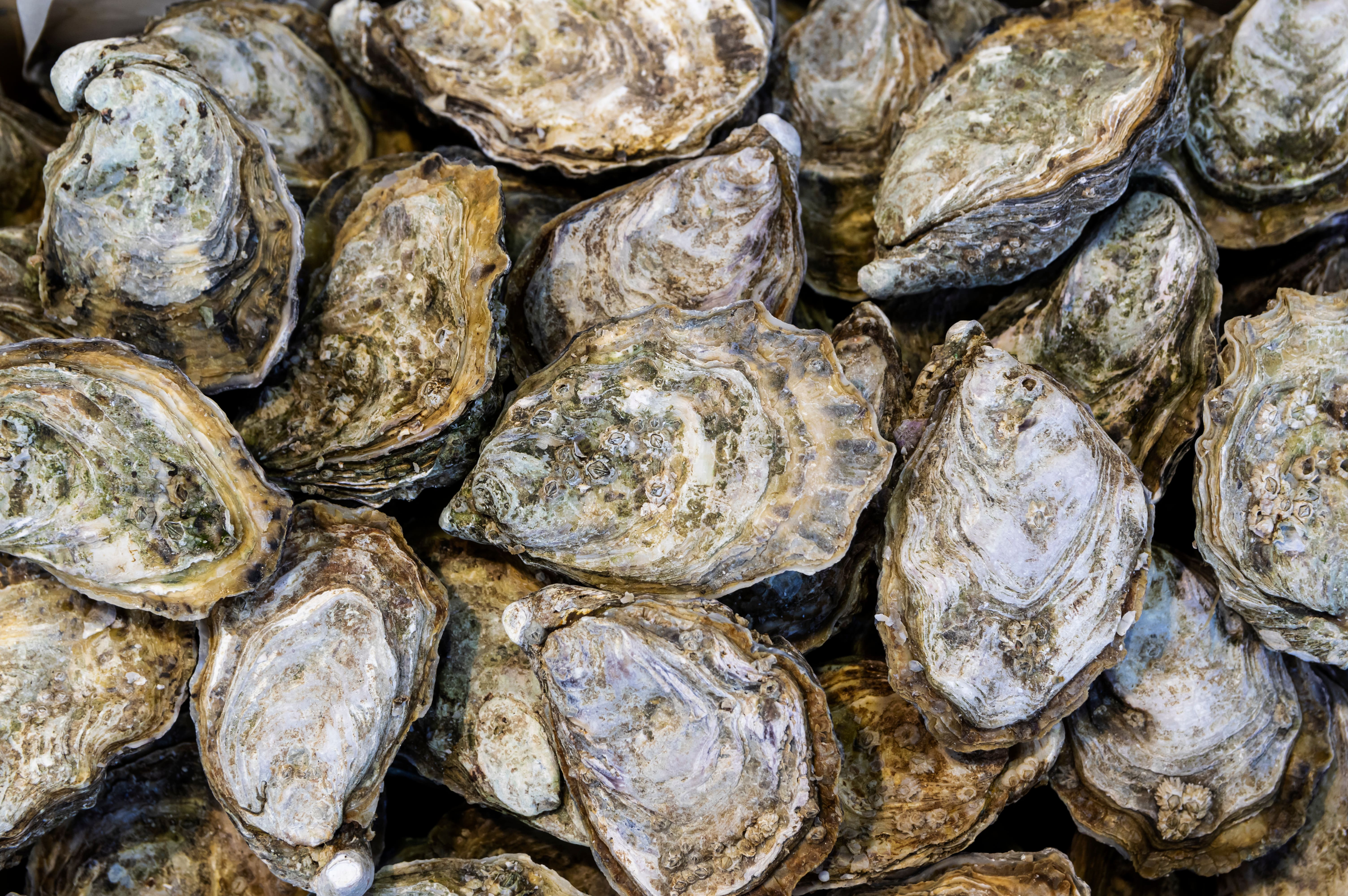
State officials last week warned coastal Alabama’s oyster harvesters that the 2026-2027 harvesting season would start later than usual and, likely, bear lower harvests. These predictions follow years of declining wild oyster harvests, raising alarms for the state’s oyster industry.
Officials with the Marine Resources Division of the Alabama Department of Conservation and Natural Resources said exploratory dives in coastal waterways found few mature oysters ready for harvest. Divers did not find many juvenile or larval oysters either, meaning harvest outlooks are not likely to improve over the next couple of years.
Given these findings, state officials have scheduled the harvesting season — which typically begins in early October — to open on Nov. 2. The harvest limit for the season will be eight sacks per day.
“Even though we’ve determined that it’s looking pretty poor out there, we’re giving you guys an opportunity to get out there,” marine biologist Jason Herrmann said at a meeting with local oystermen in Bayou La Batre last week.
Wild oysters are harvested in three locations along Mobile Bay: Cedar Point East, Cedar Point West and Heron Bay. In Alabama, a sack is 85 pounds of oysters in the shell.
However, in recent years, oyster harvests have been dramatically declining. In 2025, around 5,000 sacks were harvested in the state’s waterways, compared to around 25,000 sacks during the 2024 season. This marked the worst oyster harvest since 2017’s historically low season — when a seven-day season yielded only 136 sacks, leading state officials to cancel the season in 2018.
Low oyster populations in Mobile Bay have been caused in part by a trend of low salinity. Since 2008, periods of lower salinity in the bay have killed oysters, especially younger oysters. Oysters thrive in the brackish water of Mobile Bay, where freshwater from the state’s rivers mingles with the salt water flowing in from the Gulf of Mexico. Over the past decade, there has been a trend of heavy spring rains across the middle of the country — causing floodwaters to flow through waterways to the coast and resulting in lower salinity in brackish estuaries like Mobile Bay.
These spring rains cause low oyster spawns in the spring. While the fall spawning season is often more fruitful, many of those oysters still can’t survive the following spring season — leading to fewer and fewer oysters growing into maturity, when they can be legally harvested.
This year, salinity in oyster harvesting areas improved some, according to state officials, but it would take several years of similar conditions to see an uptick in oyster population.
“I’m hopeful that we’ll see more spat next year,” Herrmann said at last week’s meeting. “But I don’t know that for sure because I don’t know what next year is going to bring.”
Lower oyster population places strain on local oystermen, many of whom harvest wild oysters as part of small, family-run seafood businesses. Lower oyster populations mean smaller harvests, but it also means it is more time- and labor-intensive to reach harvest limits.
As wild oyster populations decline in the bay, many oystermen are turning to farming oysters — when oysters are placed and grown on artificial reefs or under piers. According to the University of South Alabama, oyster farming produces more than $3 million in oysters in Alabama each year. Building artificial oyster reefs for farming can also help rebuild and restore Mobile Bay’s marsh ecosystem, since oysters are a keystone species that are essential to the health of these estuary ecosystems.
Still, not all oystermen are onboard with farming, worried a turn toward commercial oyster farms will prevent small businesses from getting a chance to harvest at all.
“I don’t really think conservation should be involved with farm stuff,” one oysterman told FOX 10 News. “Because everybody can’t go to the farm. If you’re on that reef, anybody that gets a license or commercial can go there.”
Alabama top stories in brief
Federal judge allows Baldwin County man’s lawsuit against ICE to proceed
- U.S. District Judge Jeffrey Beaverstock last week rejected the government’s request to dismiss a lawsuit filed by a Baldwin County man who was detained three times by immigration officers in one year.
- Leo Garcia Venegas, a U.S. citizen and a Baldwin County construction worker, is suing the Trump administration for violating his Fourth Amendment rights against unreasonable search and seizures after immigration officers detained him three separate times since 2025, despite Venegas showing officers his REAL ID.
- Beaverstock is yet to rule on the lawsuit’s request for a temporary injunction against raids and detentions.
- “We know the Department of Homeland Security thinks it can raid construction sites without a warrant, round up all the workers, and refuse to credit their government-issued IDs. Now we’ll have the chance to prove these violations of the Fourth Amendment,” Institute for Justice Senior Attorney Jared McClain, who is representing Garcia Venegas, said about the ruling.
Alabama community colleges near 100,000 enrollees
- The Alabama Community College System’s board of trustees said last week that the state’s community colleges are on track to enroll 100,000 students across the state for the fall 2026 semester.
- As of last week’s meeting, 99,083 students enrolled for classes for the semester, with the system’s vice chancellor for student success, Neil Scott, saying that multiple schools are still enrolling students.
- This fall’s enrollment increased by 1.9% compared to the fall 2025 semester.
- Students are enrolled in 834,000 credit hours this semester, according to the board, up 2.7% from last fall.
- Alabama’s community college enrollment has been growing faster than the national average, with enrollment increasing 11.8% between 2024 and 2025.
Alabama union membership declines amid manufacturing plant closures
- New statistics from the U.S. Bureau of Labor Statistics show that union membership in Alabama declined last year.
- Labor union representation in the state dropped from 140,000 in 2024 to 131,000 in 2025 — decreasing from 6.6% of the workforce to 6.3%. Meanwhile union membership in the state also decreased 165,000 in 2024 to 150,000 in 2025 — or, from 7.8% of the workforce to 7.2%.
- Nationally, about 10% of the workforce is represented by unions.
- Alabama’s union membership has been decreasing since 2015, when about 10% of the workforce was represented by unions.
- In an interview with Alabama Reflector, Bren Riley, president of the Alabama AFL-CIO, said the closure of large manufacturing plants in the state in recent years — such as the closure of Gadsden’s Goodyear plant in 2020 — has led to declining union membership.
- Riley also pointed to the state’s aging population, as well as lower union engagement with younger workers, as part of the decline. According to the U.S. Census Bureau, 19% of Alabama’s population in 2025 was 65 or older.
Author

Like our work? Then support it!

Want to get early access to columns, unique newsletters and help keep The Sunrise News active? Then support us on Ko-Fi!